GNSSBox
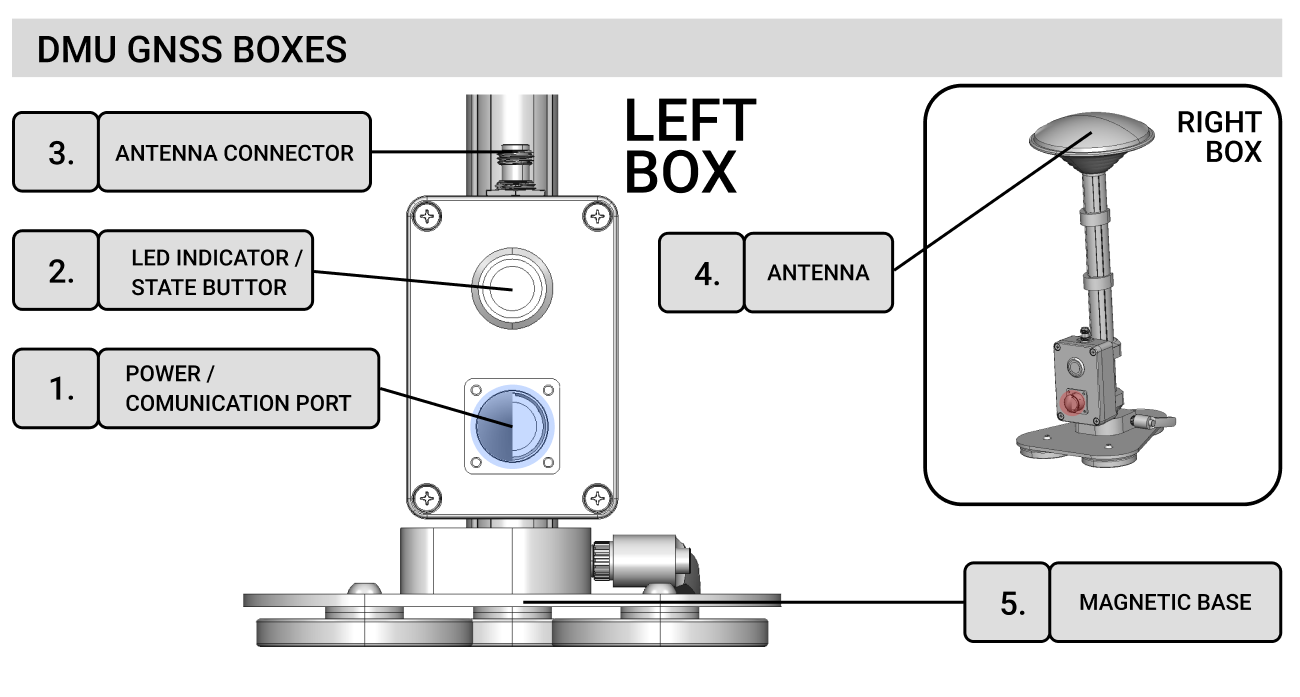
This device consists of two main components a GNSS receiver with a connected GNSS antenna, and a magnetic base GNSSBox[5]. The receiver is mounted onto a pre-surveyed location marked on the roof of the construction machine using the magnetic base (see Calibration). The receiver can be detached from the base using a special release lever on the magnetic unit.
To ensure proper system functionality, the GNSS receiver must be connected to the antenna via a coaxial cable between GNSSBox[4] and GNSSBox[3]. Two GNSSBox units are installed on the construction machine — designated as the “left” and “right” units, based on the direction of machine travel. The connector GNSSBox[1] of the left receiver must be connected to MainBox[4], while the connector GNSSBox[1] of the right receiver connects to MainBox[3].
You can also connect your own active multiband GNSS antenna to the receiver, which supports simultaneous reception of GPS, GLONASS, BeiDou, and Galileo signals and is connected via a standard TNC connector at GNSSBox[3].
LED status indicator
The GNSS receiver is equipped with a status LED and a button, which is used to activate Bluetooth pairing mode. All indicator states are listed in the following table.
| Position status | Color | Light type |
|---|---|---|
| BLE pairing | BLUE | lights |
| RTK-FIX solution | GREEN | lights |
| RTK-FLOAT solution | GREEN | blink 1Hz |
| AUTONOMUS solution (without RTK corrections) | RED | lights |
| No position calculated | RED | Blink 2Hz |
GNSS Antennas configuration
There are two types of GNSS antennas that can be used with the DMU GNSSBox:
- Basic Configuration: Drotek DA910 multiband GNSS antenna
- This antenna is suitable for standard applications and provides reliable performance in most conditions.
- It is designed for general use ensuring accurate positioning data for typical road milling operations.
- Perfect for DMU modules - CSR, CSI, JobReport etc. - this antenna is sufficient for most applications, providing a good balance between cost and performance.
- Advanced Configuration: NavXperience 3G+C multiband GNSS antenna
- This antenna offers enhanced multipath signal rejection, making it ideal for environments with potential signal interference, such as urban areas or near large structures.
- The advanced antenna is recommended for applications requiring high precision and reliability, especially in challenging environments. This antenna is preferred specially for Exact Street On Site (ESOS) applications, where precise positioning is critical.