Exact Street On Site
Overview
The Exact Street On Site module is a key module that introduces a highly automated process for road surface repairs using 3D milling, primarily for two-layer milling (layer separation). Among the main project goals that Exact Street On Site helps fulfill are minimizing or eliminating the preparatory phase of repairs (3D data collection and 3D modeling), simplifying the entire process through robotics and automation, and ensuring efficient recycling of construction materials.
The main functions of the Exact Street On Site module include data collection and management directly in the field during the road milling process. It includes a user interface (UI) for data collection that allows milling machine operators to record individual milling passes. The module collects metadata for the AdjustMT solution, including overlapping milling passes and the road axis.
It also enables real-time monitoring of whether the operator is making manual adjustments to milling depths, which helps determine the usability of field data. The system also ensures data upload from the DMU to the server and downloading of processed milling designs from the server back to the DMU. The road milling machineessentially "scanning" the milled road surface itself, which then serves as documentation of the construction progress, but also as a basis for further processing and optimization of second-layer road milling.
Usage workflow
Exact Street On Site is deeply integrated with other software and cloud services. It ensures data transmission to the server through the Remote PP2 API service and DMU API service modules. After calculations are completed (for example, through cloud optimization and AdjustMT), the user is notified and can view the results on the Optimill website and then download the file for the next milling layer, which appears in the "Cloud Storage" tab of the DMU project manager. The module also supports generating and displaying resulting cross-sections directly in the web UI or exporting them to PDF files, as well as calculating the International Roughness Index (IRI), whose results are displayed on the Optimill page.
Basic work with the Exact Street On Site module is very straightforward and includes:
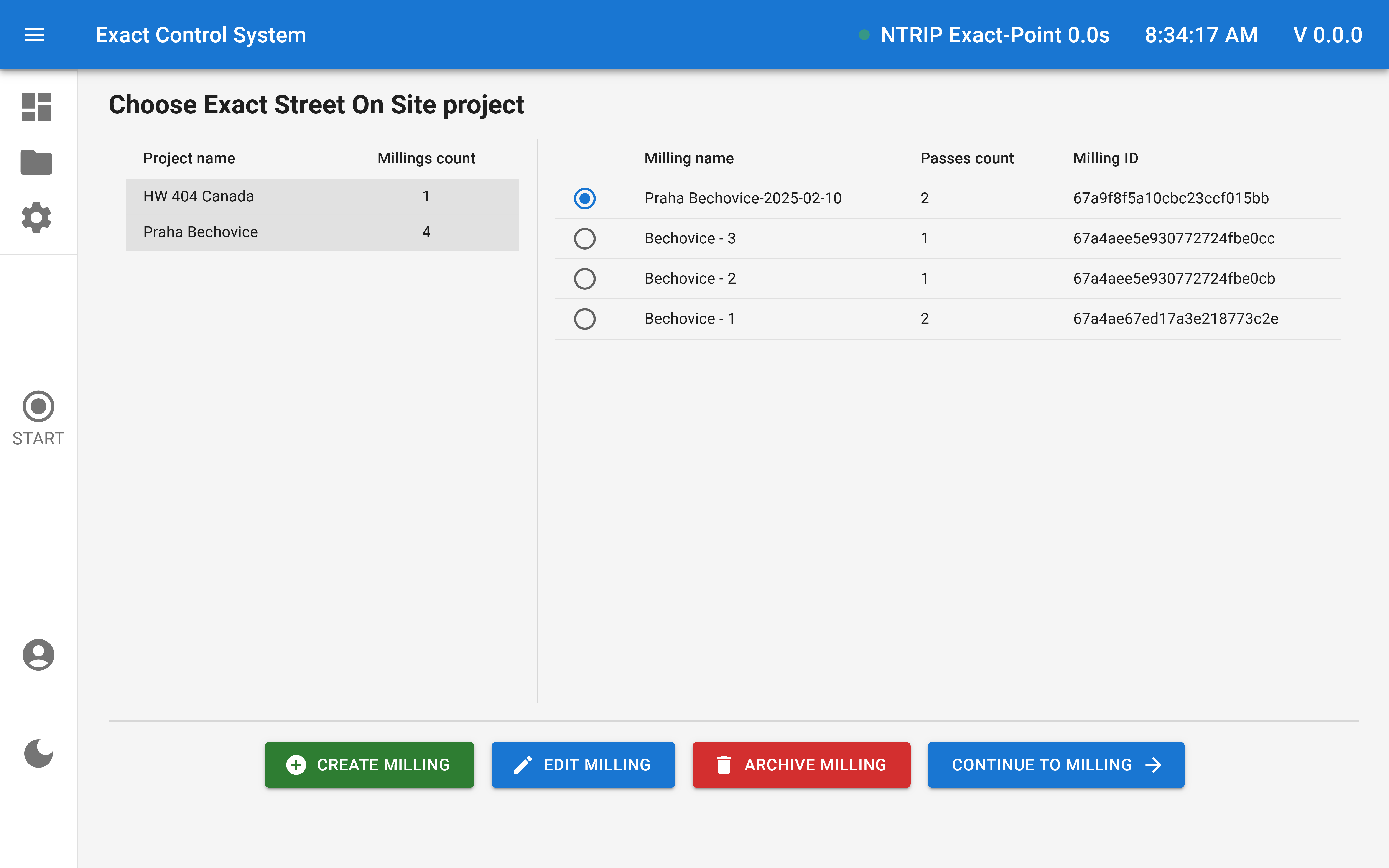
- Project selection: The user selects the project to which the given milling belongs.
- Milling selection: The user selects from a list of millings, making it possible to divide the project into multiple parts, for example by individual work shifts, which are then processed separately.
- Recording individual milling passes: The user records individual milling passes, which are stored in the DMU and continuously synchronized with the server.
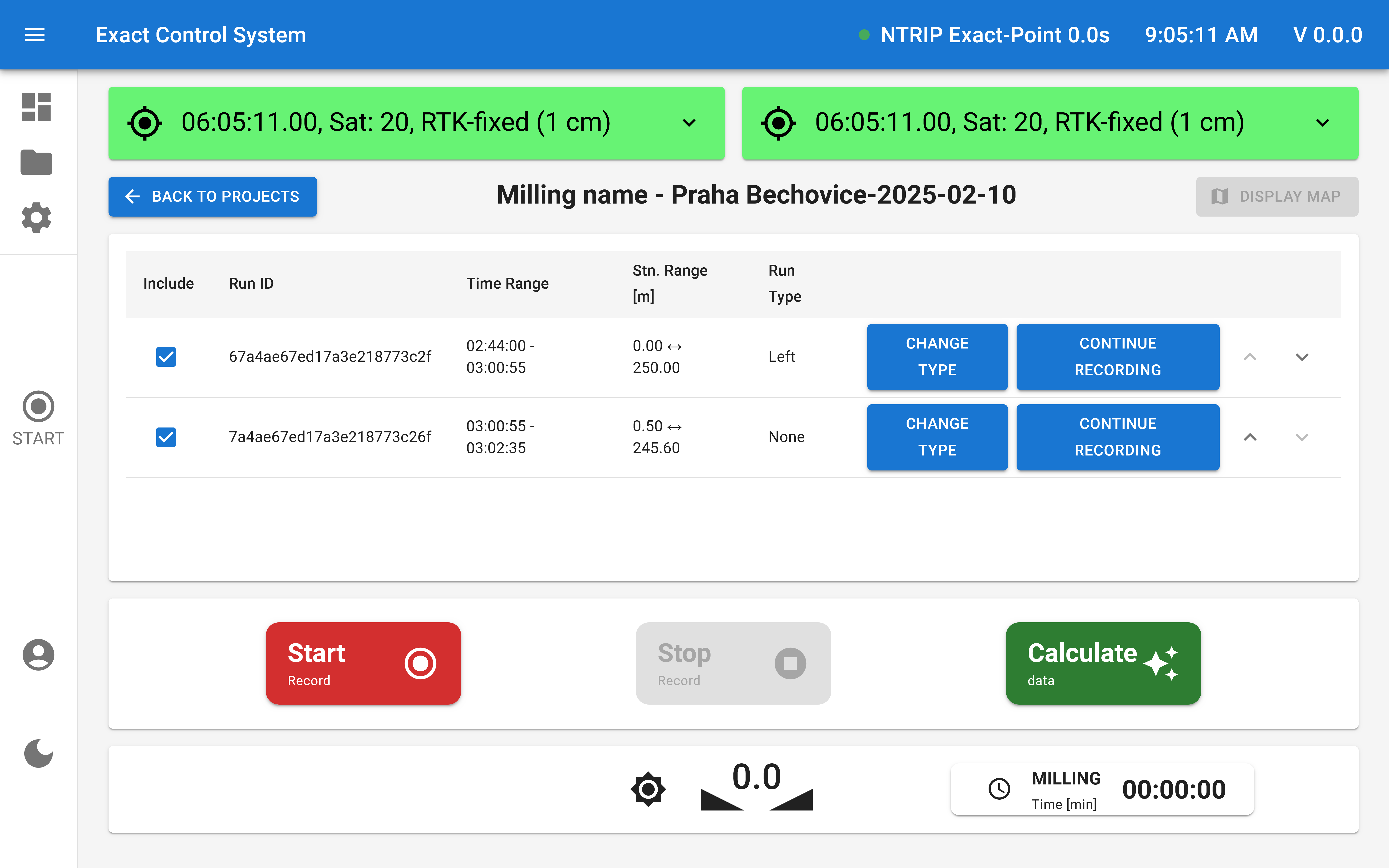
- Crown position marking: The user marks the position of the milling axis, which is then used for further processing and optimization of second-layer road milling.
- Data transmission to server: The user issues a command for final data synchronization with the cloud, which includes sending all milling passes and other metadata while simultaneously sending a signal to start calculations in the cloud.
For second-layer road milling, an optimized model is then used, which is generated based on data from the first milling, which is subsequently downloaded to the DMU and displayed in the "Cloud Storage" tab of the DMU project manager. The user can then start second-layer road milling using this optimized model in the 3D milling module (3D Differential Milling).